
-

Sapient Bodhi ranked #1 for deep research.
-
Sapient Slingshot wins Technology Breakthrough of the Year.
-

3M lines of COBOL → clear specs in 8 weeks.
-

Meet Sapient Sustain: context-aware AI for complex IT operations.


Automate the Entire Software Development Lifecycle
Sapient Slingshot is our AI platform for automating and accelerating the software development lifecycle (SDLC). With Slingshot, enterprises can modernize legacy code, build and launch new software and transform how they work.
The Slingshot platform
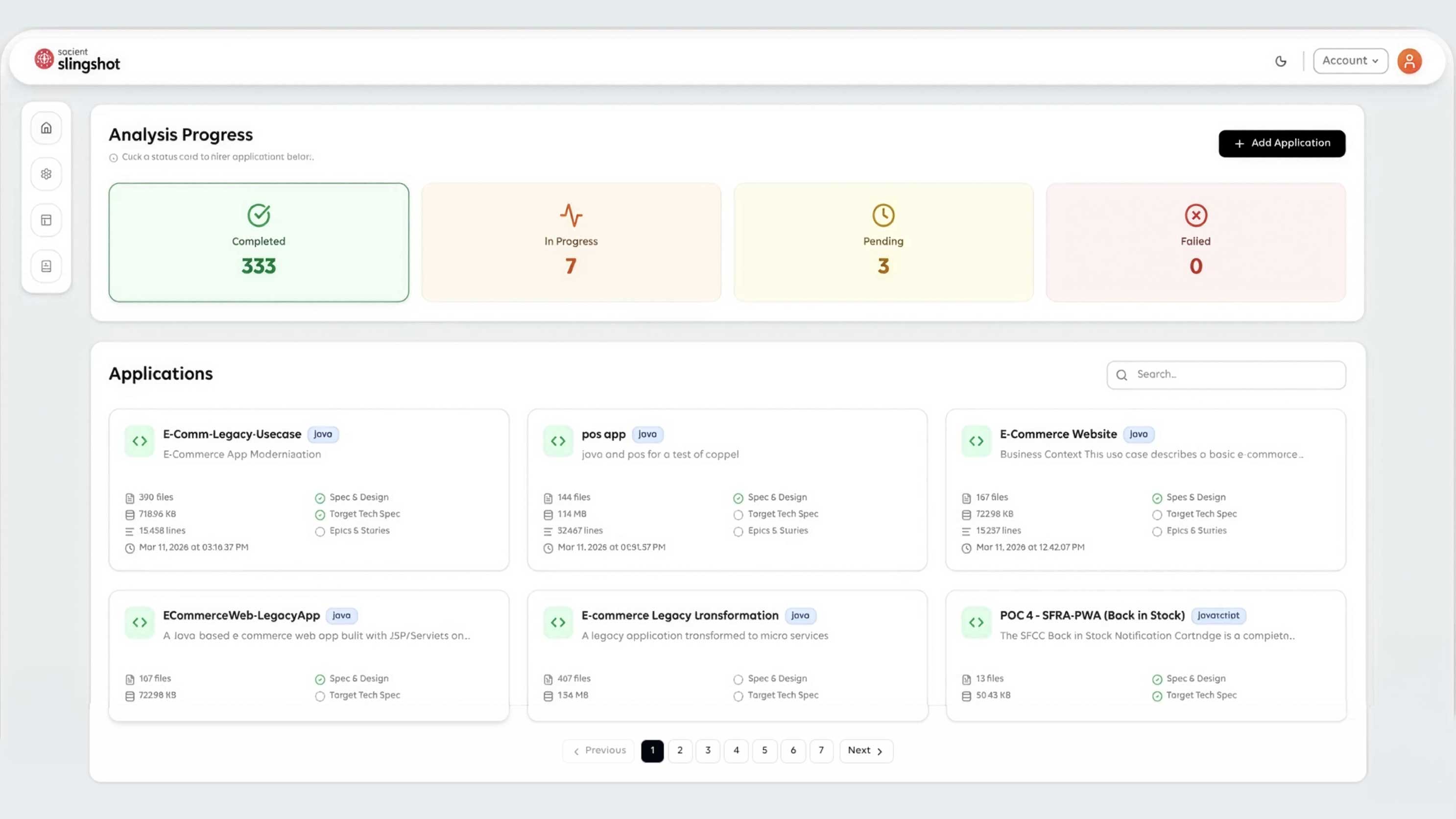
The Slingshot platform
What makes Slingshot enterprise-ready
Specialized AI agents
Specialized AI agents embedded into the platform
Prompt library
Over 1,000 tailored prompts by role, guided by our proven industry experience
Enterprise-grade
Governance and security that ensures authentication, traceability and compliance
Enterprise context graph
A system of record that captures business rules, workflows and domain knowledge
Adaptive agentic framework
Multi-agent orchestration with semantic and procedural memory
Multi-LLM and integration architecture
The model-agnostic foundation dynamically selects the best LLM for each task
How the enterprise context graph powers Slingshot
As the shared context layer behind Bodhi, Slingshot and Sustain, the enterprise context graph helps every platform become more useful, accurate and valuable over time.
Agents across the entire SDLC
A growing ecosystem of specialized agents created by our engineers to support modernization, development, testing, deployment and operations across the software lifecycle.
Break free from legacy gridlock
Legacy systems can be messy, tightly coupled and full of roadblocks. Slingshot cuts through the complexity, breaking down old code and transforming it into accurate, production-ready code in a fraction of the time.
50% reduction in modernization costs
3× faster compared to traditional approaches
Break free from legacy gridlock
Legacy systems can be messy, tightly coupled and full of roadblocks. Slingshot cuts through the complexity, breaking down old code and transforming it into accurate, production-ready code in a fraction of the time.
50% reduction in modernization costs
3× faster compared to traditional approaches
Customer stories
Leading organizations are using Slingshot to ship new software and modernize existing systems.
Health Care Organization Goes Cloud-Native
<p>faster migration</p>
<p>cost reduction</p>
The Problem
A leading health care benefits provider needed to modernize 10,000+ COBOL and Synon mainframe screens to improve claims processing and customer service.
Our Solution
With Slingshot, the provider uncovered hidden business rules and dependencies, enabling faster, safer migrations. Automated test generation sped up QA while reducing manual errors.
RWE Modernizes a Legacy App in Two Days
<p>time savings</p>
<p>efficiency gains</p>
The Problem
RWE faced an operational risk: a number of aging, undocumented applications were running on outdated technology stacks.
Our Solution
Slingshot, paired with human oversight, helped RWE revive a 24-year-old app with no source code or documentation in two days.
What our customers say
"
Beyond the tools, it’s the reimagined end-to-end development process with a human in control that I found impressive—it was a real eye-opener
"— Ryan Brudenell
Head of Digital and IT Solutions, RWE Generation UK Ltd.
Slingshot behind the scenes
Explore Slingshot’s platform architecture
Our platform architecture connects AI assistants, specialized SDLC agents and a persistent enterprise context graph with a governed technical foundation.
AI Assistants
Backlog • Scrum • Pair Programmer • Prompt Library • Living Design System
Agent Marketplace
Refactor • Blueprint • Design • Engineer • Test • Release • Deploy • Sustain
Enterprise Context Graph
Discover • Code Repos • Specs • Journeys • Data • Telemetry
Foundation
Model Garden • GPUs • MCP Gateway • Embeddings API • Authentication & Governance
Explore our resources
-
Article Digital Euro Readiness Without a Core Banking Rebuild July 30, 2026
-
Article “Time-to-Ship” Has Lost Its Meaning April 29, 2026
Slingshot FAQs
What leaders want to understand before committing Slingshot to the enterprise.
What is Sapient Slingshot?
Slingshot is an AI platform that automates and accelerates the entire software development lifecycle. It breaks down legacy systems, preserves critical business logic and generates accurate, production-ready code — while also supporting the build and launch of new software. Slingshot replaces fragmented tools and manual handoffs with a single, continuous system for modernizing and delivering software at enterprise scale.
How does Slingshot modernize legacy systems without increasing risk?
Slingshot reads existing code to extract rules, dependencies and specifications before anything is rebuilt. That logic is carried forward through code generation, testing and deployment so modernized systems behave exactly as intended. This approach reduces guesswork, limits rework and avoids the common failures of rewrite-from-scratch modernization.
How is Slingshot different from AI coding tools or copilots?
AI coding tools assist individual developers. Slingshot modernizes and delivers software at the system level. Slingshot carries enterprise context across discovery, design, build, test and deployment. It is built for large, tightly coupled systems where accuracy, traceability and governance matter — not just faster code completion.
Can Slingshot be used to build new software as well as modernize legacy code?
Yes. Slingshot supports both legacy modernization and net-new software development on the same platform. Teams can modernize existing systems while simultaneously building and launching new applications, without waiting for long transformation programs to finish. This allows enterprises to keep shipping while legacy systems catch up.
What outcomes can enterprises expect from using Slingshot?
Enterprises use Slingshot to reduce modernization timelines, cut manual effort and improve delivery reliability across the SDLC. Common outcomes include 75 percent faster delivery, 40 percent higher productivity, up to 50 percent savings in modernization costs and 99 percent code-to-spec accuracy.